
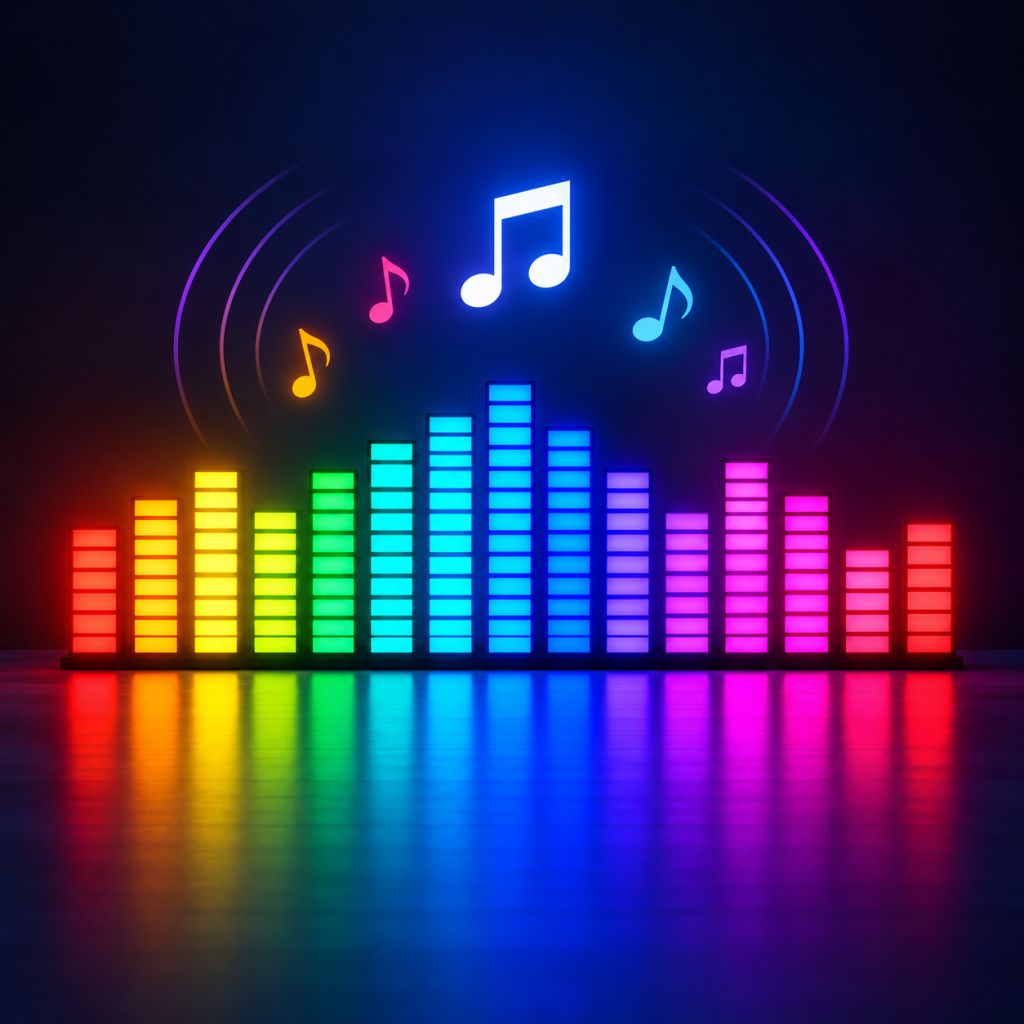
If you have seen colorful LED bars moving in synchronization with music, you may have wondered how they work.
These devices are commonly known as music reactive LED equalizers, music visualizers or LED spectrum displays.
They combine an audio-reactive controller with LED lighting to convert sound into real-time visual effects.
What Does “Music Reactive” Mean?
“Music reactive” means that the lighting responds to the audio signal.
Instead of displaying a fixed lighting pattern, the LEDs change according to the music.
For example, when a bass-heavy beat plays, the lower-frequency response can become stronger. When vocals or high-frequency sounds increase, different parts of the LED display can react.
This creates a visual representation of the music.
What Is an LED Equalizer?
An LED equalizer is essentially a physical version of the audio visualizers commonly seen on computers, smartphones and music players.
Traditional software equalizers display frequency levels on a screen.
A physical LED equalizer uses rows or bars of LEDs to create the same type of visual effect in the real world.
This makes the system ideal for decorative and entertainment applications.
Bass, Mid and Treble
One of the key features of a modern music reactive LED system is frequency visualization.
The audio spectrum can generally be divided into three main areas:
Bass
Bass represents low-frequency sounds.
Examples include:
- Kick drums
- Bass guitars
- Sub-bass
- Deep electronic beats
Mid
Mid frequencies contain many important elements of music.
Examples include:
- Vocals
- Guitar
- Piano
- Snare drums
- Many instruments
Treble
Treble represents higher-frequency sounds.
Examples include:
- Cymbals
- High percussion
- Electronic effects
- High vocal frequencies
By responding to these frequency ranges, the LED equalizer can create a more dynamic visual representation of the music.
What Comes With a 16-Bar LED Equalizer?
A complete 16-bar system can include:
- 16 LED bars
- 50 cm per bar
- Music reactive LED controller
- Connection cables
- 110–220V to 5V power supply
- Remote control
The upgraded controller allows users to select different lighting modes and effects.
Why Are RGB LEDs Important?
Full-color RGB LEDs provide significantly more visual possibilities than single-color LEDs.
Instead of displaying only one color, RGB LEDs can create combinations of:
- Red
- Green
- Blue
- Cyan
- Purple
- Pink
- Yellow
- White
- Multicolor effects
With more than 100 lighting effects, users can select different visual styles depending on the environment and type of music.
How Can You Install It?
There are many possible installation styles.
For example, the LED bars can be arranged:
Horizontally
Ideal for TV walls, bars, DJ booths and desks.
Vertically
Suitable for walls, studios and stage decorations.
Custom Patterns
Creative installations can combine different heights and positions to create a larger visual display.
The modular 16-bar design makes it possible to adapt the system to different spaces.
Is It Suitable for Professional Use?
The LED equalizer can be used in both personal and commercial environments.
Popular applications include:
- Home entertainment
- Bars
- Nightclubs
- Events
- Parties
- DJ setups
- Recording studios
- Music production spaces
- Gaming rooms
The best configuration depends on the size of the space and the desired visual effect.
Final Thoughts
A music reactive LED equalizer is a simple concept with a powerful visual impact.
It takes something you normally hear — music — and turns it into something you can see.
With a 16-bar system, full-color LEDs, multiple lighting effects and Bass-Mid-Treble visualization, you can create a unique lighting experience for almost any music environment.
Turn your music into light. See the sound.